CASE_006
Gordo
The Player
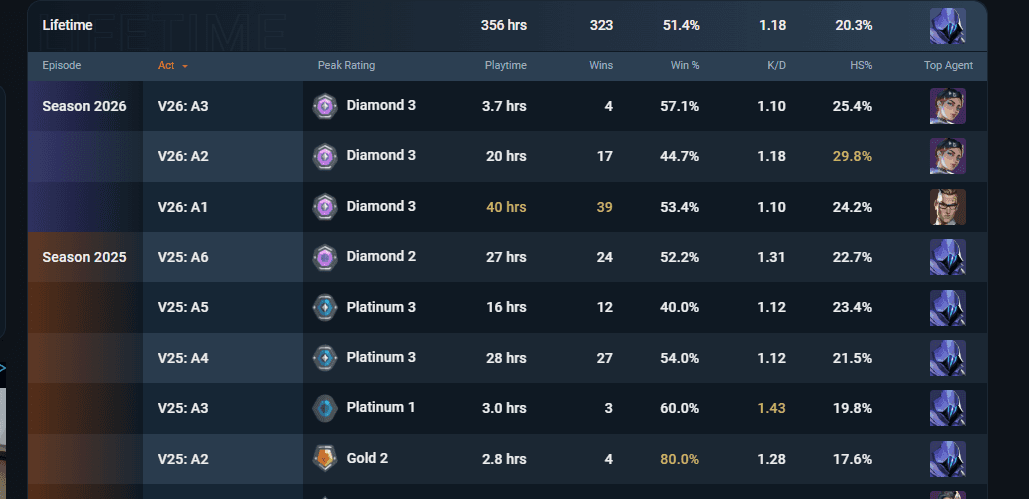
Gordo came to us a year ago. Gold 2, stuck there for seven Acts after climbing from Bronze in his first year of Valorant. The plateau wasn't talent — it was structure. Or rather, the absence of it.
He's a university student on a GPA-dependent scholarship, which meant his time on Valorant was real but constrained: roughly two hours a day on weekdays, more on weekends when school allowed. A smoker player by preference — Omen and Astra his comfort picks, Chamber and Viper added later — with a clear competitive goal underneath the casual love of the game: he wanted to play for his university's Valorant team. Immortal was the rank required to make the main roster.
He didn't have glaring weaknesses. He had something subtler — a thousand small leaks that had compounded over a year of grinding ranked without a system. The way most players plateau.
The Diagnosis
Daniel's first session notes flagged three core issues:
Peeking technique. Strafe rhythm was off — he was shooting through his own movement rather than between strafes, which made his aim less reliable than his mechanical baseline suggested.
Team-relative positioning. He was playing his agents the way solo-queue smokers often do — focused on smokes and utility, less focused on where his teammates actually were. He wasn't playing for trades, which is the real currency of ranked. In ranked, you don't always get to play the textbook angle. You play the angle that lets your team trade the fight if you lose it.
Minimap awareness. Related to the above. He wasn't tracking enemy last-seen positions or his team's spacing closely enough to make positioning decisions in real time. He was reading the game one duel at a time, not one round at a time.
He wasn't a "wrong habits" case. He was a clean slate with no system — and the one habit he had picked up was over-indexing on being a smoker, treating utility usage as the job and the gunfight as secondary. The opposite of how ranked actually rewards smokers.
The personalized training regimen has been absolutely crucial to making sure the time I spend on Valorant is as efficient as possible — without the weekly and monthly schedule and the monthly VOD review, I'd still be a bodyshot enthusiast in low gold.
— Gordo
The Program
The constraint shaped the program. Two hours a day meant we couldn't afford to spend any of them on the wrong work.
Daniel built a tight weekday routine — 30 to 35 minutes, designed to compound without eating his ranked time:
5 minutes of free warmup — open the game, hand wakes up, get the feel back.
15 minutes of a targeted drill — varies daily, addressing a specific weakness.
15 minutes of a second targeted drill — same logic, different focus.
The drills rotated across his specific gaps:
Strafe — rebuilding the rhythm of shoot, strafe, shoot so the shots and the movement stopped overlapping.
Normal Death Match — focused on specific mechanics, not just queueing for kills.
100 Bots — flicking under volume.
Normal Flick — flick technique isolation. The drill behind reliable, consistent aim.
Micro Adjustments — the single most underrated aim skill in Valorant. If your crosshair placement is good, you rarely need huge flicks. You need to micro-adjust onto a head with precision. This wins gunfights at every rank.
Silent Death Match — DM with no sound. Forces correct clearing and peeking technique because you can't react to audio cues. The brain has more bandwidth for proper habit-building.
Spray Control — Valorant spray feels random but isn't. The pattern varies, but not enough to be unpredictable. A drilled skill, not a guessed one.
Weekends, when his schedule loosened, the routine expanded to an hour — adding 30 minutes of aim training on Kovaak's, with a custom playlist Joni built for him covering flicking, micro adjustments, and a small amount of tracking. Tailored to Valorant, not generic aim training.
The cadence:
One 90-minute 1-1 with Daniel every month — the recalibration point. What worked, what didn't, what gets adjusted.
Weekly check-ins with Daniel via text, occasionally a short call when something needed to be shown rather than typed.
Async access on Discord whenever a question came up mid-week.
The routine itself was never static. As Gordo progressed, exercises got swapped, lengths got adjusted, the aim routine got rebuilt twice. A program that never adapts isn't personalized — it's a template with a name on it.
The Arc
Month | Phase | What happened |
|---|---|---|
MO 01 | Intake | Gameplay audit. Three core leaks identified: peeking, team-relative positioning, minimap awareness. Tight weekday routine built around 30-35 min/day. Gold 2 baseline. |
MO 02–03 | Foundation | Routine installed and adhered to. Strafe and flick mechanics started showing in ranked. Climbed Gold 2 → Platinum 3 by end of month 3. |
MO 04–05 | Consolidation | Plateaued at Plat 3 for two months. Refinement of utility usage and trade-focused positioning during this stretch. |
MO 06 | Breakthrough | Diamond 2 reached. The team-play habits clicked — he stopped playing as a smoker and started playing as a teammate who smokes. |
MO 07–08 | Pushing | Climbed to Diamond 3 by month 8. School load increased; play time dropped. |
MO 08–12 | Maintenance | Held Diamond 3 across the back half of the year as exams ate his schedule. Some weeks of training were skipped entirely. No rank regression — the structural work held under reduced volume. Made the university second team during this stretch. |
The Outcome
The number that matters isn't the rank — it's the time. Gordo never increased his hours. The plateau dissolved because the hours started compounding.
Before · MO 01 | Current · MO 12 | |
|---|---|---|
Rank | Gold 2 | Diamond 3 |
RR climbed | — | ~710 (estimated) |
Hours/day | ~2 (variable) | ~2 (variable) |
Routine adherence | 0% | Consistent — pauses only for exams |
University team | Not enrolled | Second team — secured |
Status | Plateaued at Gold for 7 acts | Climbing, ongoing |
What Gordo Said
The most important part of getting better (and thus ranking up), in my opinion, as someone who has climbed up from Bronze to Gold myself and now Gold to Diamond with coaching is learning how to learn. With the coaching that I've had so far, the hard part of 'learning to learn' is now as easy as sending a message to Daniel or Joni and getting a thorough, helpful explanation of literally any question you have about Valorant, on top of your VOD reviews and what I found to be every bit as helpful as the VOD review, the personalized mechanics training schedule. You don't need to wade through mountains of mostly garbage YouTube advice from people who only want your watch-time when you have Daniel's extremely curated and personal advice. I fully believe that if I wasn't so focused on school, I'd be ascendant or even immortal by now, given the consistency and effective support given by MeliusX.
— Gordo
Credits
Role | Name |
|---|---|
Head Coach · 1-1 Sessions · VOD Review · Routine Design · Check-ins | Daniel — Ex-Radiant, ex-VCL |
Aim Coaching · Custom Kovaak's Playlists (months 01–03) | Joni Kurti — Ex-Immortal, Aimlabs Top 723 |
The Player | Gordo — for twelve months of showing up to the routine while carrying a scholarship-dependent GPA. We gave him the map and the rails. The training, the discipline, and the climb were his. |
Program | Bottega · 12 months · ongoing |